


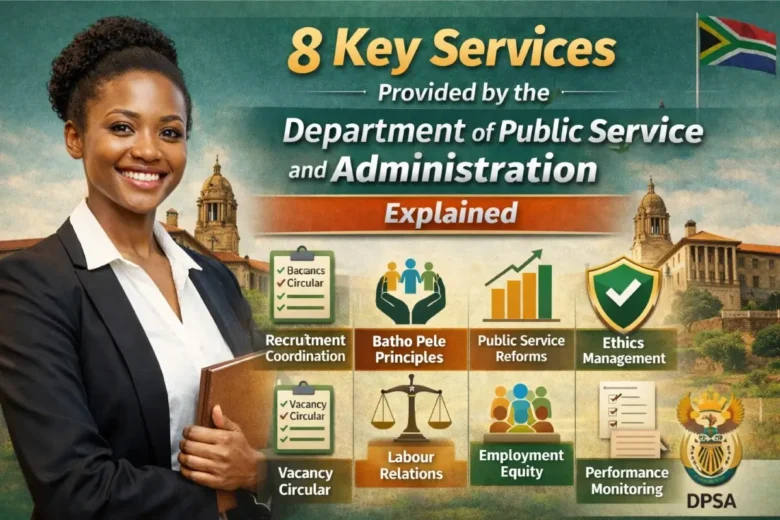
8 Key Services Provided by the Department of Public Service and Administration (DPSA) Explained
The Department of Public Service and Administration (DPSA) is one of the most influential departments in South Africa, yet it is also one of the most misunderstood. Many people only associate DPSA with job vacancy circulars, but its responsibilities go far beyond that. DPSA designs, regulates, and monitors how the entire public service operates, from recruitment rules to ethical conduct and labour relations.
If you are applying for government jobs, working in the public service, or planning a long-term career in government, understanding DPSA’s key services gives you a real advantage. Below are eight core services provided by DPSA, explained clearly and practically.
1. Recruitment Coordination Across the Public Service
DPSA does not hire employees directly, but it coordinates and regulates how recruitment must be done across national and provincial departments.
This service includes:
- Setting recruitment and selection policies
- Standardising job advertising formats
- Ensuring fair and competitive recruitment processes
- Monitoring compliance by departments
Because of DPSA’s recruitment coordination role, all departments must follow the same rules when advertising and filling posts. This is why job adverts across departments look similar and require the same documents, such as the Z83 form.
For job seekers, this means:
- Recruitment is rule-based, not random
- Non-compliant applications are rejected automatically
- Understanding DPSA rules helps you apply correctly everywhere
Official source: https://www.dpsa.gov.za
2. Management of the DPSA Vacancy Circular
One of DPSA’s most visible services is publishing the official Public Service Vacancy Circular. This circular is the primary platform for advertising government jobs.
Key facts:
- Released weekly (usually Fridays)
- Includes vacancies from national and provincial departments
- Contains reference numbers, requirements, and closing dates
- Serves as the official proof that a post exists
Any legitimate public service job must appear in this circular or on an authorised departmental platform. DPSA uses this service to promote transparency and equal access to employment opportunities.
Job seekers who follow the circular closely apply earlier, avoid scams, and focus only on verified opportunities.
Vacancy portal: https://www.dpsa.gov.za/dpsa2g/vacancies.asp
3. Implementation of the Batho Pele Principles
Batho Pele (“People First”) principles are a cornerstone of public service delivery in South Africa. DPSA is responsible for developing, promoting, and monitoring the implementation of these principles across government.
The Batho Pele principles include:
- Consultation
- Service standards
- Access
- Courtesy
- Information
- Openness and transparency
- Redress
- Value for money
DPSA ensures departments align their operations and staff conduct with these principles. This affects how public servants interact with citizens and how services are delivered.
For job seekers and public servants, Batho Pele explains why customer service, ethics, and accountability are emphasized in government roles.
4. Public Service Policy Development and Reform
DPSA plays a leading role in designing and reforming public service policies. This includes reviewing outdated systems and introducing reforms to improve efficiency and accountability.
Examples of policy areas include:
- Organisational structures
- Performance management systems
- Human resource development
- Digital transformation in government
These reforms shape how departments function internally and how public servants are managed. For employees, this determines promotion pathways, performance assessments, and workplace expectations.
For job seekers, DPSA reforms influence:
- New types of posts created
- Skills demanded by government
- Changes in recruitment criteria
5. Ethics Management and Anti-Corruption Oversight
Ethics management is one of DPSA’s most critical services. The department enforces ethical conduct standards for all public servants.
This service includes:
- Development of the Public Service Code of Conduct
- Management of financial disclosure frameworks
- Conflict of interest regulations
- Anti-corruption coordination
Public servants are required to declare financial interests, avoid conflicts, and comply with integrity rules. Violations can result in disciplinary action or dismissal.
For applicants, this means:
- Background checks may be conducted
- False declarations can lead to disqualification
- Ethical compliance is taken seriously from recruitment stage
6. Labour Relations Framework in the Public Service
DPSA provides policy leadership on labour relations within the public service. This service ensures fair treatment of employees while maintaining service delivery.
Key responsibilities include:
- Setting labour relations policies
- Supporting collective bargaining frameworks
- Managing disciplinary and grievance procedures
- Ensuring alignment with labour legislation
While bargaining happens in structures like the Public Service Coordinating Bargaining Council (PSCBC), DPSA defines the policy environment that governs these engagements.
For job seekers, this means government employment operates under structured labour protections, not informal agreements.
7. Employment Equity and Diversity Management
DPSA ensures the public service complies with the Employment Equity Act and promotes diversity and inclusion.
This service involves:
- Setting employment equity targets
- Monitoring departmental equity plans
- Reporting on workforce demographics
- Promoting inclusion of people with disabilities
Employment equity affects recruitment outcomes, especially when candidates are equally qualified. DPSA’s oversight ensures transformation goals are pursued lawfully and transparently.
Understanding this service helps job seekers realistically interpret recruitment outcomes and policy priorities.
8. Monitoring and Evaluation of Public Service Performance
DPSA monitors how well departments implement public service policies and standards. This service focuses on accountability and continuous improvement.
It includes:
- Evaluating HR and organisational performance
- Assessing compliance with DPSA directives
- Recommending corrective measures
- Supporting capacity building
This ensures departments do not ignore policies once they are issued. For employees, it affects performance reviews and institutional audits. For job seekers, it reinforces why compliance and documentation matter in applications.
Why DPSA Services Matter to Job Seekers
Every government job application, interview process, salary level, and career progression path is influenced by DPSA services. Understanding DPSA helps job seekers:
- Apply correctly
- Avoid disqualification
- Identify real opportunities
- Build sustainable public service careers
For simplified updates, vacancy explanations, and government job guidance, many job seekers rely on trusted platforms such as https://wikihii.co.za, which breaks down DPSA information in plain language.
You can also stay updated through this WhatsApp channel that tracks public service vacancies and DPSA developments:
https://whatsapp.com/channel/0029VbClgTjFi8xUxCo3Dc2y
8 Key Services Provided by the Department of Public Service and Administration (DPSA) Explained
The Department of Public Service and Administration is not just an administrative office—it is the architect of South Africa’s public service system. From recruitment coordination and Batho Pele principles to ethics management and labour relations, DPSA shapes how government works and who gets hired.
Job seekers who understand DPSA’s services position themselves better for success, while those who ignore it often apply blindly and fail repeatedly. Knowledge of DPSA is not optional—it is strategic.
